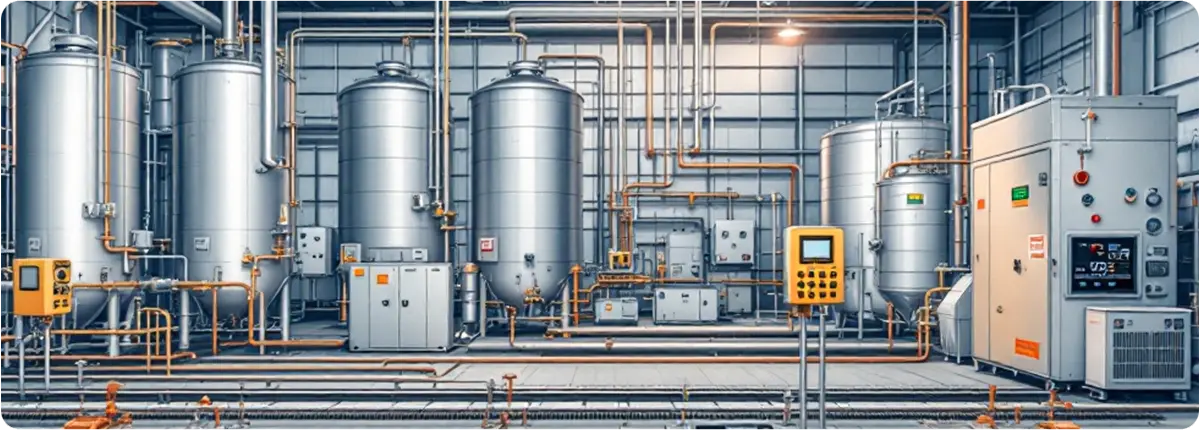
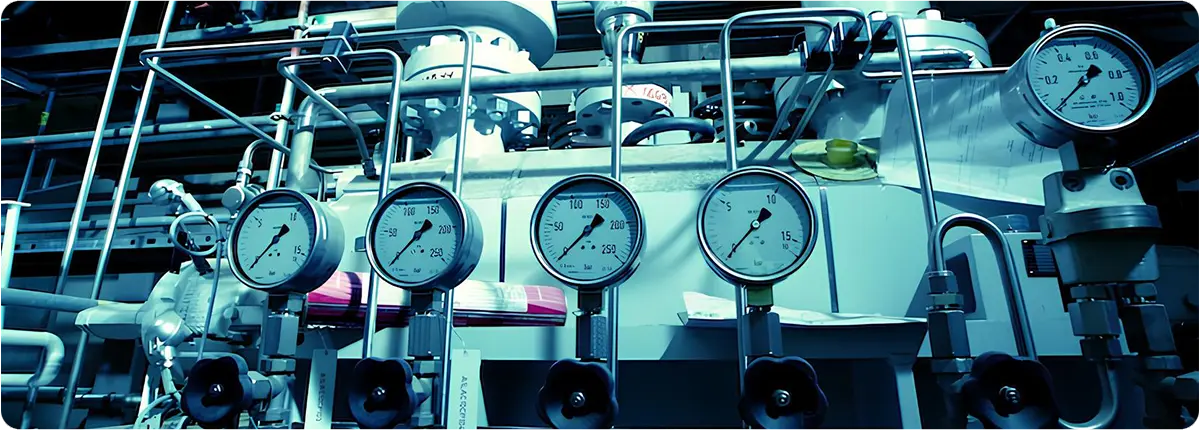
Coriolis flowmeters are among the most accurate instruments for directly measuring mass flow. Based on the Coriolis effect, these devices can simultaneously measure additional parameters such as fluid density, temperature, and viscosity. Due to their unmatched accuracy, they are widely used in chemical, petrochemical, food, pharmaceutical, energy, and oil & gas industries.
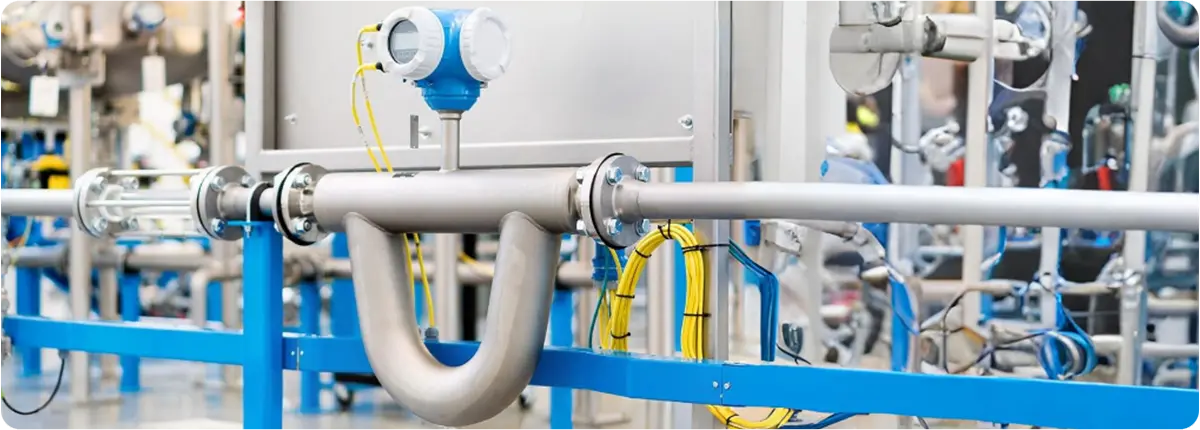
Coriolis Flowmeters

WORKING PRINCIPLE

Coriolis flowmeters measure mass flow by detecting the phase shift caused when fluid passes through vibrating tubes. The tubes are set into oscillation by electromagnetic drivers. As the fluid flows, a measurable phase difference appears between the inlet and outlet ends of the tube, which is proportional to the mass flow.

Basic equation:
ṁ = k · Δφ
ṁ: mass flow rate (kg/s), k: calibration constant, Δφ: phase shift (radians).

Additionally, the natural vibration frequency of the tubes is used to measure fluid density:
ρ = f(ω)
ρ: density, ω: vibration frequency.

STRUCTURAL FEATURES

  • Measuring tubes: U-shaped or dual straight tube designs
  • Materials: Stainless steel, Hastelloy, or corrosion-resistant alloys
  • Sensors: Electromagnetic or optical detection
  • Output: 4-20 mA, HART, Profibus, Modbus, Foundation Fieldbus
  • Additional functions: Density, temperature, and viscosity measurement

ADVANTAGES AND LIMITATIONS

Advantages:

  • Direct mass flow measurement
  • Very high accuracy (±0.1% – ±0.2%)
  • Simultaneous density and temperature measurement
  • No moving parts, minimal maintenance

Limitations:

  • High initial cost
  • Heavy and expensive for large pipe diameters
  • Sensitive to vibrations and installation conditions

APPLICATION AREAS

  • Chemical and petrochemical industry: measurement of acids, bases, and solutions
  • Oil and gas industry: mass flow measurement
  • Food and beverage production: sugar solutions, milk, beer, etc.
  • Pharmaceutical industry: precise formulations
  • Energy sector: fuel feed and process control

STANDARDS AND CALIBRATION

  • ISO 10790: International standard for Coriolis flowmeters
  • OIML R 137: International standard for gas flow measurement devices
  • ATEX-certified versions: For explosive environments
  • Regular calibration is essential to maintain accuracy

CONCLUSION

Coriolis flowmeters provide unmatched accuracy and versatility by offering direct mass flow measurement combined with density and temperature monitoring. They are indispensable instruments in modern process industries, particularly where precision and reliability are critical.
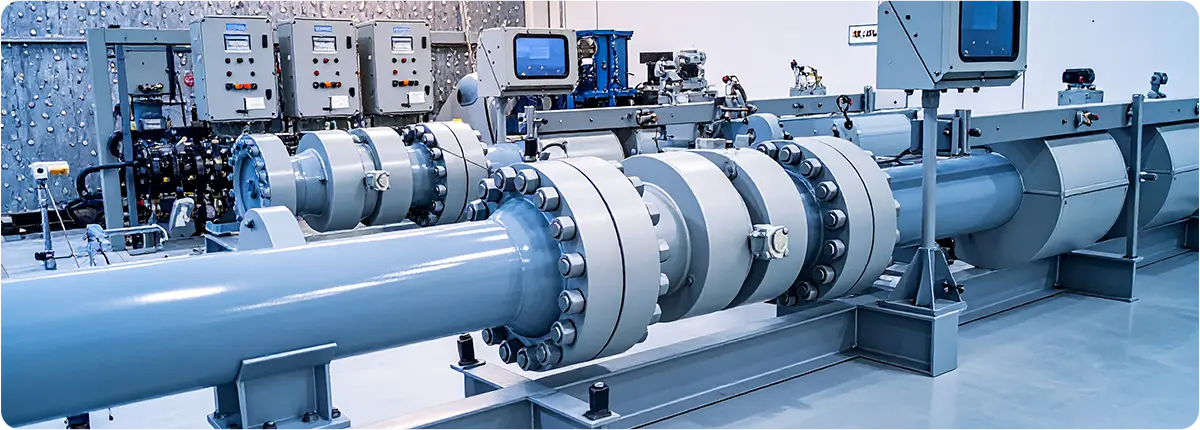
Ultrasonic flowmeters are modern instruments that measure flow using the propagation of sound waves. They are highly durable due to their non-intrusive design, require minimal maintenance, and can measure liquids, gases, and multiphase flows. They are widely used in water management, energy, petrochemical, food, and pharmaceutical industries.

Ultrasonic Flowmeters and Industrial Applications

WORKING PRINCIPLE

Ultrasonic flowmeters operate primarily using two methods: transit-time difference and Doppler effect.

• Transit-time method: Measures the difference in travel time between ultrasonic signals sent with and against the flow. This difference is proportional to flow velocity.

Basic equation:
v = (Δt · c²) / (2 · L · cosθ)
v: fluid velocity, Δt: time difference, c: speed of sound, L: distance between sensors, θ: angle of the signal

• Doppler method: Measures the frequency shift of sound waves reflected from particles or bubbles in the fluid. The shift is directly proportional to flow velocity.

STRUCTURAL FEATURES

  • Sensors: Mounted externally (clamp-on) or inserted into the pipe
  • Measurement range: from very low to high flow rates
  • Outputs: Pulse, 4-20 mA, HART, Profibus, Modbus
  • Data integration: Digital display and SCADA compatibility

ADVANTAGES AND LIMITATIONS

Advantages:

  • Non-intrusive measurement (clamp-on)
  • No moving parts, low maintenance
  • High accuracy (±0.5% – ±1)
  • Suitable for liquids, gases, and multiphase flows

Limitations:

  • Accuracy affected by fluid temperature, viscosity, and pipe material
  • Performance decreases in non-homogeneous flows
  • Doppler method requires particles or bubbles in the fluid

APPLICATION AREAS

  • Water and wastewater monitoring
  • Measurement in oil and gas pipelines
  • Cooling water control in power plants
  • Hygienic flow measurement in food and beverage industry
  • Process control in pharmaceutical production

STANDARDS AND CALIBRATION

  • ISO 6416: Standard for ultrasonic flow measurement
  • AGA reports: Gas measurement standards
  • ATEX-certified models for explosive environments
  • Regular calibration required to maintain accuracy

CONCLUSION

Ultrasonic flowmeters have become essential in modern industries thanks to their non-intrusive design, accuracy, and low maintenance requirements. Their ability to integrate with digital communication protocols makes them a reliable choice for process automation and optimization.

Turbine flowmeters are highly accurate instruments that measure flow by detecting the rotational speed of a turbine placed in the flow path. As the fluid moves through the pipe, it spins the turbine, and the speed of rotation is proportional to the flow velocity. They are widely used in oil, natural gas, chemical, food, pharmaceutical, and water management industries.

WORKING PRINCIPLE

The fluid flow turns the turbine rotor, and its rotational speed corresponds to the volumetric flow rate. Magnetic or optical sensors detect the rotor’s movement and convert it into an electrical signal.

Basic equation:
Q = k · N

Where Q is the flow rate (m³/s), k is the calibration constant, and N is the number of turbine revolutions per unit time.

STRUCTURAL FEATURES

  • Material: stainless steel, aluminum, or special alloys
  • Rotor: aerodynamically designed to minimize resistance
  • Bearings: sapphire or tungsten carbide for long life and low friction
  • Output: Pulse signal, 4-20 mA, HART, Modbus

ADVANTAGES AND LIMITATIONS

Advantages:

  • High measurement accuracy (0.2% – 0.5% error)
  • Wide flow measurement range
  • Suitable for both gases and liquids

Limitations:

  • Accuracy decreases with viscous or contaminated fluids
  • May be unstable at very low flow rates
  • Requires periodic calibration and maintenance

APPLICATION AREAS

  • Fuel measurement in oil and gas industry
  • Natural gas consumption monitoring in power plants
  • Flow control in water management and treatment facilities
  • Measurement of liquid raw materials in food and pharmaceutical industries

STANDARDS AND CALIBRATION

  • ISO 9951: Turbine meters for gas flow measurement
  • AGA reports: Standards for natural gas measurement
  • API and ASME compliance
  • Regular calibration required to maintain accuracy

CONCLUSION

Turbine flowmeters provide exceptional accuracy and reliability in industrial flow measurement. With digital communication protocols, they can be seamlessly integrated into SCADA and automation systems, playing a vital role in process optimization and monitoring.

Flow measurement is one of the most essential parameters in industrial processes. Accurate flow monitoring ensures energy optimization, process safety, and product quality. Variable area flowmeters, most commonly represented by rotameters, are widely used due to their simplicity and reliability.

Flow Measurement Techniques

WORKING PRINCIPLE

A variable area flowmeter consists of a tapered tube with a float inside. As fluid flows upward, the float rises until the upward force of the fluid balances with gravity. The position of the float corresponds to the flow rate, which can be read directly.

Q = C · A(h) · √(2ΔP / ρ)

Where Q is flow rate (m³/s), C is discharge coefficient, A(h) is the cross-sectional area depending on float height, ΔP is pressure drop, and ρ is fluid density.

MAIN COMPONENTS

  • Tapered glass or metal tube
  • Float element
  • Scale and indicator system
  • Optional: Electronic sensors and transmitter integration

ADVANTAGES AND LIMITATIONS

Advantages:

  • Simple and robust design
  • Direct visual reading
  • No external energy required

Limitations:

  • Sensitive to viscosity and density variations
  • Cannot be used in horizontal pipelines
  • Limited accuracy in high-precision processes

APPLICATION AREAS

  • Water and wastewater treatment plants
  • Chemical industry for liquids and gases
  • Laboratory environments for low flow rates
  • Food and pharmaceutical industries for basic process control

STANDARDS AND CALIBRATION

  • ISO 5167: Flow measurement devices
  • OIML R117: International metrology standard for liquid flow measurement devices
  • Periodic calibration is required to ensure accuracy

CONCLUSION

Variable area flowmeters remain widely used due to their low cost, simplicity, and reliability. The introduction of electronic rotameters has enabled digital monitoring and integration with SCADA systems, making them more versatile in modern industries.

Temperature measurement is one of the most critical parameters in industrial processes. In industries such as chemical, energy, food, and pharmaceuticals, accurate temperature monitoring is essential for process safety, product quality, and energy efficiency.

Temperature Measurement Methods and Sensors

PRINCIPLES OF TEMPERATURE MEASUREMENT

Temperature reflects the thermal energy of a system. There are two main categories of measurement:

  • Contact Measurement: Thermocouples, Resistance Temperature Detectors (RTDs), thermistors.
  • Non-Contact Measurement: Infrared (IR) sensors, pyrometers.

FUNDAMENTAL EQUATIONS AND RELATIONSHIPS

The Stefan-Boltzmann law explains the relationship between temperature and radiation:

E = σ · T⁴

Where E is emitted energy (W/m²), σ is the Stefan-Boltzmann constant (5.67 × 10⁻⁸ W/m²K⁴), and T is absolute temperature (K).

For RTDs, the resistance-temperature relationship is given by:

R(T) = R₀ (1 + αΔT)

Where R(T) is resistance at temperature T, R₀ is reference resistance, and α is the temperature coefficient.

TYPES OF TEMPERATURE SENSORS

  • Thermocouples: Widely used, cost-effective, suitable for broad temperature ranges.
  • RTDs: Provide high accuracy and long-term stability.
  • Thermistors: High sensitivity in narrow temperature ranges.
  • Infrared Sensors: Enable non-contact measurement, ideal for moving or high-temperature objects.
  • Pyrometers: Suitable for extremely high-temperature applications (e.g., metallurgy, glass industry).

FACTORS AFFECTING MEASUREMENT ACCURACY

  • Sensor placement and installation
  • Emissivity of the measured surface
  • Environmental conditions (dust, vapor, humidity)
  • Frequency and precision of calibration

STANDARDS AND CALIBRATION

  • IEC 60751: Standards for RTD sensors.
  • IEC 60584: Standards for thermocouples.
  • ISO 17025: Accreditation for calibration laboratories.

APPLICATION AREAS

  • Reactor temperature control in chemical industries
  • Turbine and boiler temperature monitoring in power plants
  • Cooking and cooling processes in the food industry
  • Sterilization processes in the pharmaceutical industry

CONCLUSION

Temperature measurement systems are indispensable for ensuring safety and quality in industrial processes. With proper sensor selection, calibration, and maintenance, temperature measurements can be carried out reliably and sustainably.

Flow measurement is one of the most fundamental parameters in industrial processes. Accurate flow measurement is essential for production efficiency, energy optimization, process safety, and product quality.

Flow Measurement Techniques

PRINCIPLES OF FLOW MEASUREMENT

Flow rate is defined as the quantity of fluid passing through a cross-sectional area. The basic formula is:

Q = A · v

Where Q is volumetric flow rate (m³/s), A is cross-sectional area (m²), and v is flow velocity (m/s).

Mass flow rate can be expressed as:

ṁ = ρ · Q

Where ṁ is mass flow rate (kg/s), ρ is fluid density (kg/m³).

TYPES OF FLOW MEASUREMENT DEVICES

  • Orifice Plates: Simple and cost-effective, but with higher pressure losses.
  • Venturi Tubes: Provide higher accuracy with lower pressure drop.
  • Pitot Tubes: Suitable for gases and low-viscosity fluids.
  • Electromagnetic Flowmeters: Highly accurate for conductive liquids.
  • Ultrasonic Flowmeters: Offer non-contact measurement.
  • Mass Flowmeters (Coriolis): Directly measure mass flow with high precision.

FACTORS AFFECTING MEASUREMENT ACCURACY

  • Changes in fluid temperature and viscosity
  • Pipe diameter and roughness
  • Installation position of the flowmeter
  • Calibration and maintenance issues

STANDARDS AND CALIBRATION

  • ISO 5167: For orifice, venturi, and nozzle-based flow measurement devices
  • ISO 4185: Standard for flowmeter calibration
  • ISO 17025: Accreditation for calibration laboratories

APPLICATION AREAS

  • Flow monitoring in water and wastewater treatment plants
  • Steam and fuel flow measurement in power plants
  • Reactor and pipeline flow control in chemical industries
  • Liquid flow control in food and beverage industries

CONCLUSION

Flow measurement systems are critical for ensuring reliable and efficient production in industrial plants. Proper device selection, correct installation, and regular calibration guarantee process continuity and safety.

Pressure measurement plays a vital role in industrial processes by ensuring safety, product quality, and energy efficiency. Inaccurate pressure readings can lead to equipment failures, production losses, and safety hazards. Therefore, the selection and use of the right pressure measurement systems are essential.

Pressure Measurement Systems and Transducers

PRINCIPLES OF PRESSURE MEASUREMENT

Pressure is defined as the force exerted per unit area:

P = F / A

Where P is pressure (Pa), F is force (N), and A is surface area (m²).

Types of pressure:

  • Absolute Pressure: Measured relative to a perfect vacuum.
  • Gauge Pressure: Measured relative to atmospheric pressure.
  • Differential Pressure: The difference between two pressure points.

TYPES OF PRESSURE SENSORS

  • Bourdon Tubes: Mechanical indicators, cost-effective but limited in precision.
  • Differential Pressure Transducers: Widely used for flow measurement and filter monitoring.
  • Piezoelectric Sensors: Provide high sensitivity for dynamic pressure changes.
  • Capacitive Pressure Sensors: Offer high accuracy and long-term stability.
  • Strain Gauge Sensors: Measure pressure through changes in electrical resistance.

FUNDAMENTAL EQUATIONS AND MEASUREMENT EXAMPLES

Hydrostatic pressure formula:

P = ρ · g · h

Where ρ is fluid density (kg/m³), g is gravitational acceleration (9.81 m/s²), and h is fluid height (m).

Flow rate derived from differential pressure:

Q = C · √ΔP

Where Q is flow rate (m³/s), C is the flow coefficient, and ΔP is the pressure difference (Pa).

FACTORS AFFECTING MEASUREMENT ACCURACY

  • Temperature variations and thermal drift
  • Sensor calibration and accuracy
  • Vibrations in the pipeline
  • Installation conditions and environmental influences

STANDARDS AND CALIBRATION

  • ISO 5167: Standard for differential pressure measurement devices.
  • IEC 61298: Defines test methods for pressure transducers.
  • ISO 17025: Accreditation requirements for calibration laboratories.

APPLICATION AREAS

  • Reactor pressure control in chemical industries
  • Steam line monitoring in power plants
  • Pipeline pressure monitoring in oil and gas sectors
  • Process pressure management in the food and beverage industry

CONCLUSION

Pressure measurement systems are critical to ensuring safety and efficiency in industrial plants. By selecting the appropriate sensor, performing regular calibration, and ensuring proper maintenance, processes can be managed reliably and sustainably.

Level measurement is one of the most vital aspects of industrial processes. Accurate level control in storage tanks, silos, and pipelines is essential for production efficiency, process safety, and cost optimization.

Level Measurement Systems and Sensors

LEVEL MEASUREMENT METHODS

  • Mechanical Methods: Float systems and level indicators; simple but limited in accuracy.
  • Hydrostatic Method: Calculates liquid level from the pressure at the tank bottom using pressure sensors.
  • Ultrasonic Sensors: Perform non-contact measurements using sound waves. May be affected by foam and vapor.
  • Radar (Microwave) Sensors: Provide high accuracy and reliability, suitable for challenging process conditions.
  • Capacitive Sensors: Measure changes in dielectric constant, applicable for both liquids and solids.

BASIC PRINCIPLES AND FORMULAS

Hydrostatic level measurement formula: P = ρ · g · h

Where P is pressure (Pa), ρ is fluid density (kg/m³), g is gravitational acceleration (9.81 m/s²), and h is level height (m).

Capacitive level measurement formula: C = (ε · A) / d

Where C is capacitance (F), ε is dielectric constant, A is plate area, and d is distance between plates.

FACTORS AFFECTING MEASUREMENT ACCURACY

  • Variations in fluid density, temperature, and viscosity
  • Tank geometry and sensor installation position
  • Foam, vapor, and pressure fluctuations
  • Calibration and regular maintenance of sensors

STANDARDS AND CALIBRATION

  • IEC 60079: For explosion-proof level sensors in hazardous environments.
  • ISO 9001: Process validation and quality management standards.
  • ISO 17025: Accreditation for calibration laboratories.

APPLICATION AREAS

  • Monitoring tank and basin levels in water and wastewater treatment plants
  • Reactors and storage tanks in chemical industries
  • Liquid raw material monitoring in the food industry
  • Tank level management in oil and gas industries

CONCLUSION

Level measurement systems are critical for ensuring process safety and efficiency. Correct sensor selection, proper installation, and regular calibration allow industrial plants to operate reliably and sustainably.

Temperature is one of the most critical parameters in industrial processes. Incorrect temperature measurement can lead to reduced product quality, energy inefficiency, and even serious safety risks. For this reason, temperature measurement systems and sensors are integral parts of process control.

Temperature Measurement Methods and Sensors

PRINCIPLES OF TEMPERATURE MEASUREMENT

Temperature measurement is used to determine the energy state of fluids or solids. The fundamental formula is:

Q = m · c · ΔT

Where Q is heat energy (J), m is mass (kg), c is specific heat capacity (J/kgK), and ΔT is the temperature change (K).

Heat transfer mechanisms — conduction, convection, and radiation — must be considered when positioning temperature sensors.

TYPES OF TEMPERATURE SENSORS

• Thermocouples: Based on the Seebeck effect, suitable for a wide temperature range.
• RTDs (Resistance Temperature Detectors): Measure resistance changes, offering high accuracy.
• Thermistors: Provide very precise readings over a narrower temperature range.
• Infrared (IR) Sensors: Enable non-contact temperature measurement.
• Bimetal Thermometers: Simple mechanical devices operating on thermal expansion.

FACTORS AFFECTING MEASUREMENT ACCURACY

• Calibration of the sensor
• Immersion depth and sensor positioning
• Environmental conditions such as humidity, vibration, and electromagnetic interference
• Quality of insulation materials

If these factors are not considered, measurement errors may increase significantly.

STANDARDS AND CALIBRATION

• IEC 60751: International standard for RTD sensors.
• ASTM E230: Defines thermocouple classes and tolerances.
• ISO 17025: Accreditation standard for calibration laboratories.

APPLICATION AREAS

• Turbine and boiler temperature monitoring in power plants
• Reactor temperature measurement in chemical industries
• Pasteurization and cooking processes in the food industry
• Ambient temperature control in HVAC systems

CONCLUSION

Selecting the right sensor, performing regular calibration, and ensuring proper installation make temperature measurement systems indispensable for safety, efficiency, and product quality in industrial operations.

Flow measurement is one of the most critical parameters in industrial processes. The amount, velocity, and characteristics of a fluid directly affect product quality and system efficiency in industries such as power generation, water treatment, petrochemicals, and food production.

Flow Measurement Techniques

FLOW CONCEPT AND BASIC FORMULA

Flow (Q) is the volume of fluid passing through a cross-section per unit of time.

Formula:
Q = A · v

Where Q (m³/s) is the flow rate, A (m²) is the pipe cross-sectional area, and v (m/s) is the average velocity.

The Bernoulli principle, which describes the conservation of energy in a fluid, forms the basis of many flow measurement techniques.

MECHANICAL MEASUREMENT METHODS

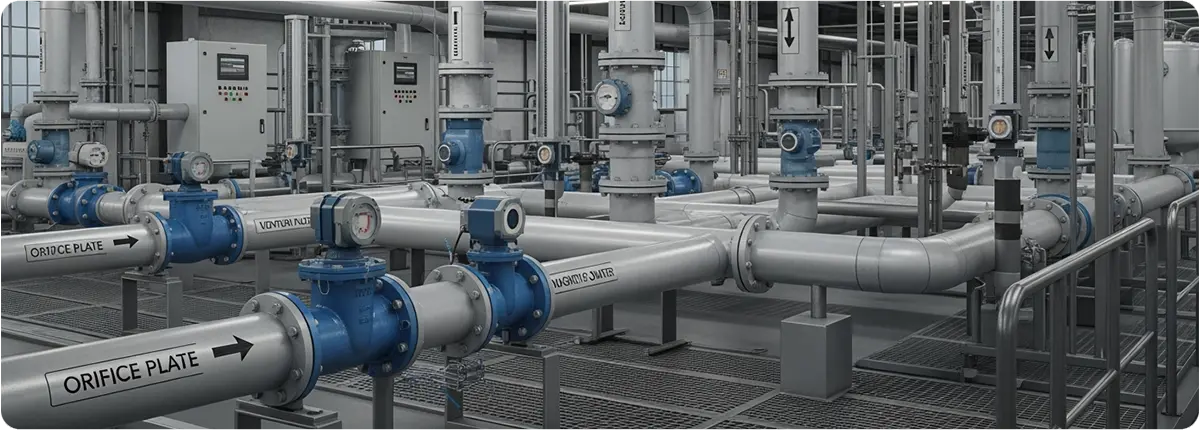
• Orifice Plate: Based on pressure drop; a cost-effective but less accurate method.
• Venturi Tube: Provides higher accuracy with minimal pressure loss.
• Pitot Tube: Commonly used for velocity measurement.
These methods are defined under ISO 5167 standards.

MODERN FLOW MEASUREMENT TECHNOLOGIES

• Ultrasonic Flowmeter: Measures the effect of the fluid on sound waves; has no moving parts.
• Magnetic Flowmeter: Works on electromagnetic induction principle; suitable for conductive fluids.
• Mass Flowmeter (Coriolis): Directly measures mass flow with high accuracy, widely used in critical applications.

FACTORS AFFECTING MEASUREMENT ACCURACY

• Fluid viscosity
• Changes in temperature and density
• Turbulence within the pipeline
• Installation conditions and sensor placement

Ignoring these factors may result in significant measurement errors.

CALIBRATION AND STANDARDS

Regular calibration of flow measurement devices is necessary. ISO 5167 defines calibration methods for differential pressure devices such as orifice and Venturi tubes. Additionally, AGA reports (e.g., AGA3) are widely applied in natural gas flow measurement.

INDUSTRIAL APPLICATIONS

• Monitoring liquid and gas flows in petrochemical industries
• Steam and water flow control in power plants
• Inlet/outlet flow monitoring in water treatment plants
• Accurate liquid measurement in food industry processes

CONCLUSION

Accurate flow measurement is essential for process safety and efficiency. Proper device selection, compliance with standards, calibration, and correct installation conditions ensure reliable and sustainable operation of industrial facilities.