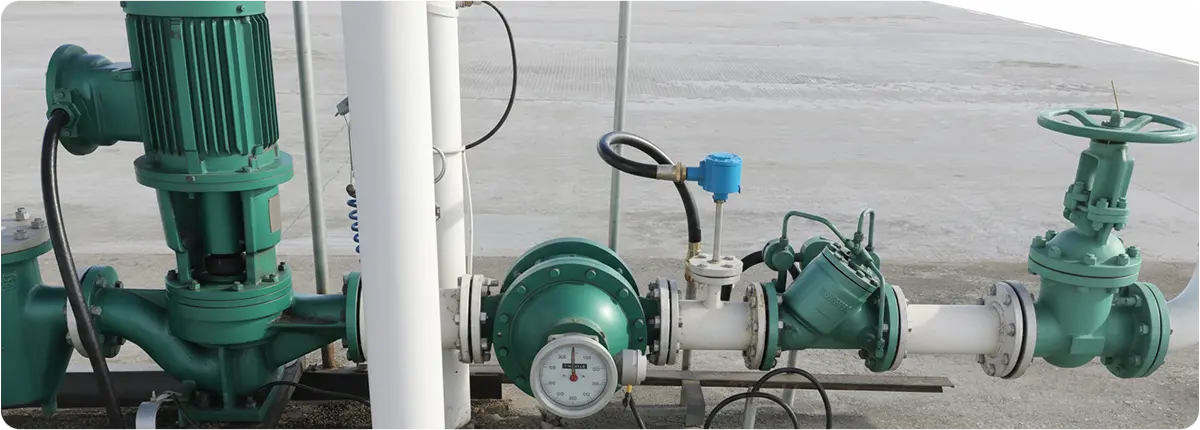
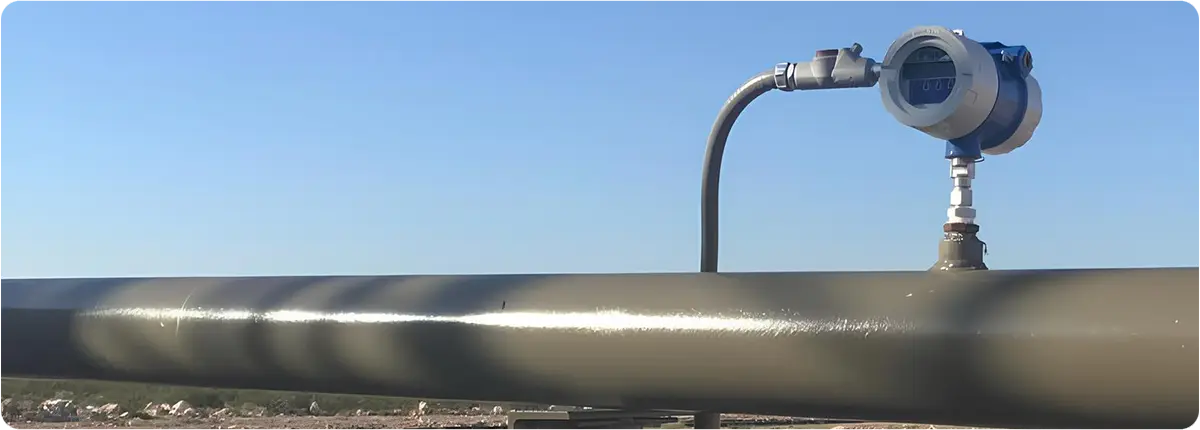
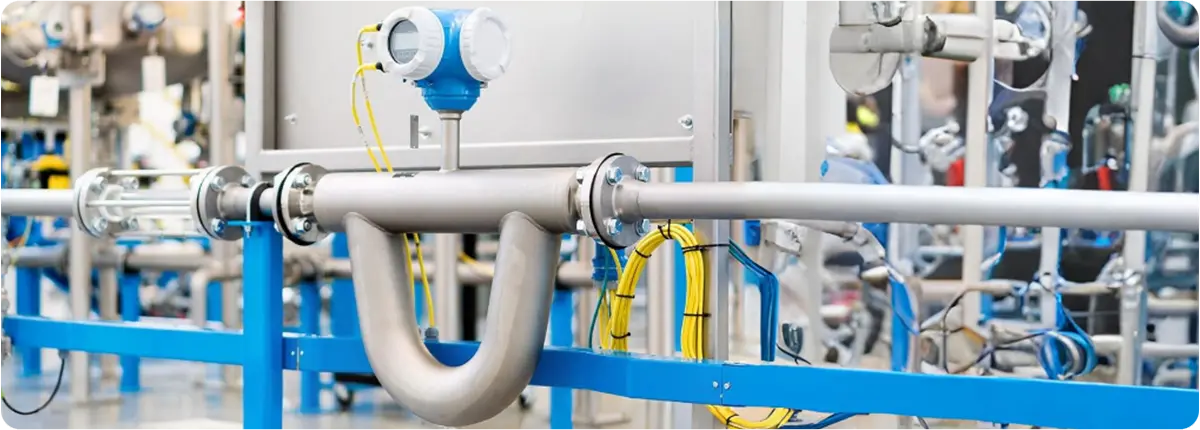
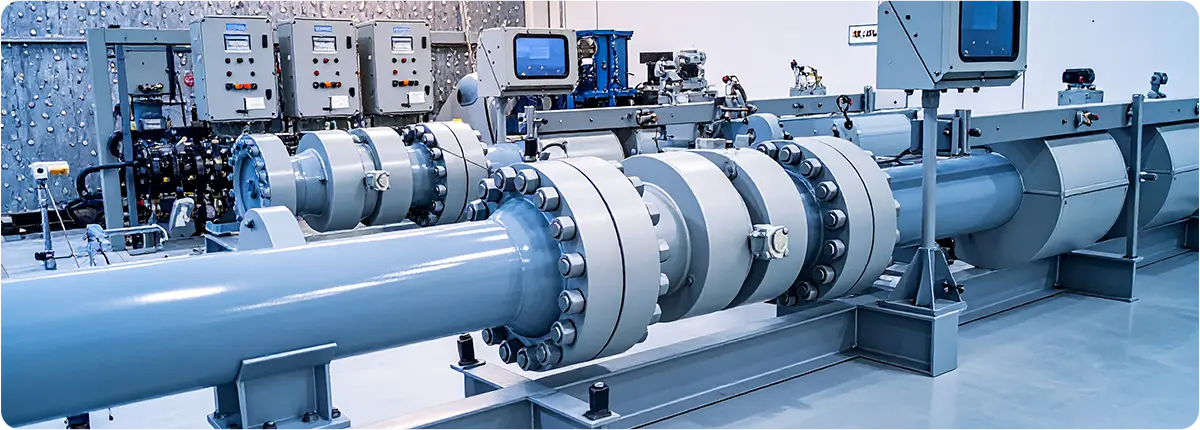
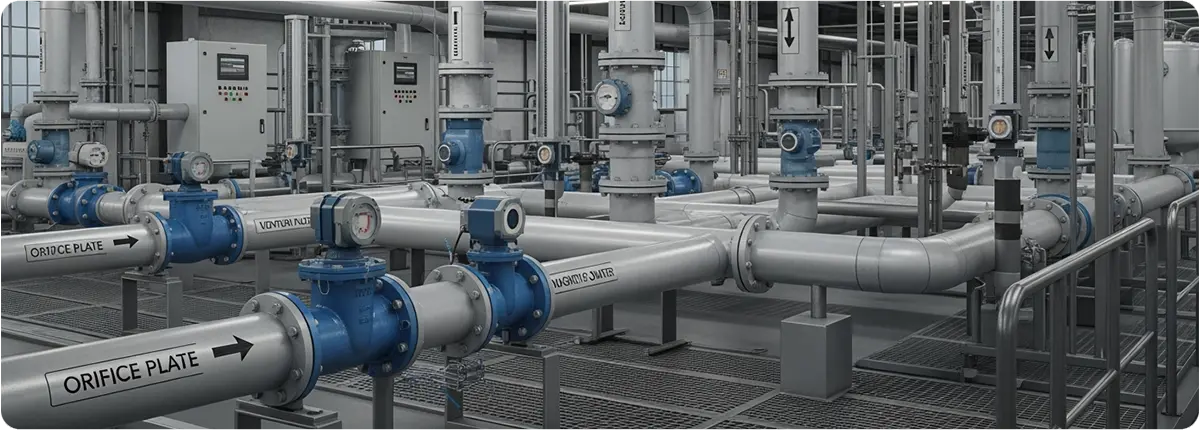
Oval gear flowmeters are one of the most common types of positive displacement flowmeters. They operate on the principle of two oval-shaped gears rotating as fluid passes through them. Each rotation corresponds to a fixed volume, enabling highly accurate volumetric flow measurement. Their reliability with high-viscosity fluids makes them popular in chemical, petroleum, food, and pharmaceutical industries.
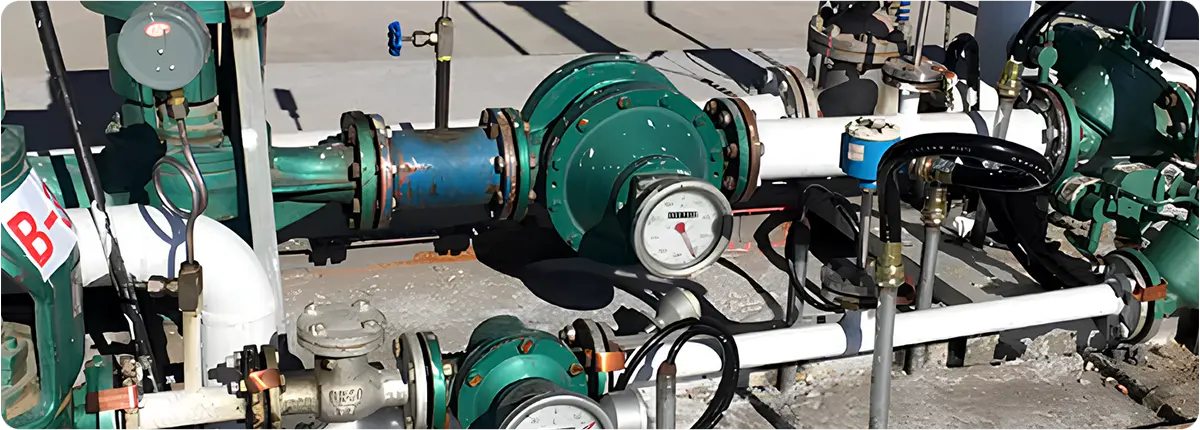
Oval Gear Flowmeters

WORKING PRINCIPLE

As the fluid flows through the meter, it rotates two intermeshing oval gears. Each rotation displaces a constant amount of fluid, which is detected by sensors. The total flow is calculated by multiplying the number of rotations by the volume per rotation.

Basic equation:
Qv = n · Vc
Qv: volumetric flow rate (m³/s)
n: gear rotation frequency (Hz)
Vc: displaced volume per rotation (m³).

Oval gear flowmeters are particularly effective for low flow rates and viscous fluids.

STRUCTURAL FEATURES

  • Body materials: stainless steel, aluminum, cast iron
  • Measuring element: two oval-shaped gears
  • Output signals: magnetic pickup, pulse, digital signals
  • High-pressure resistance
  • Low pressure drop and wide measuring range

ADVANTAGES AND LIMITATIONS

Advantages:

  • High accuracy (±0.1% – ±0.5%)
  • Reliable measurement at low flow rates
  • Excellent performance with viscous fluids
  • Compact and durable design

Limitations:

  • Requires maintenance due to moving parts
  • Reduced lifespan with abrasive or particulate fluids
  • Limited by high-temperature conditions

APPLICATION AREAS

  • Solvent and polymer measurement in chemical industries
  • Precise fuel and oil monitoring in petroleum industry
  • Syrup, honey, and oil measurement in food industry
  • Precise dosing in pharmaceutical industry
  • Lubrication systems in energy and automotive sectors

STANDARDS AND CALIBRATION

  • OIML R 117: International standard for liquid measuring devices
  • ISO/IEC 17025: Calibration laboratory accreditation
  • ATEX-certified models for explosive environments
  • Regular calibration is necessary to maintain accuracy

CONCLUSION

Oval gear flowmeters provide high accuracy and reliability, making them one of the most trusted solutions for industrial flow measurement. They are especially advantageous for measuring viscous fluids.
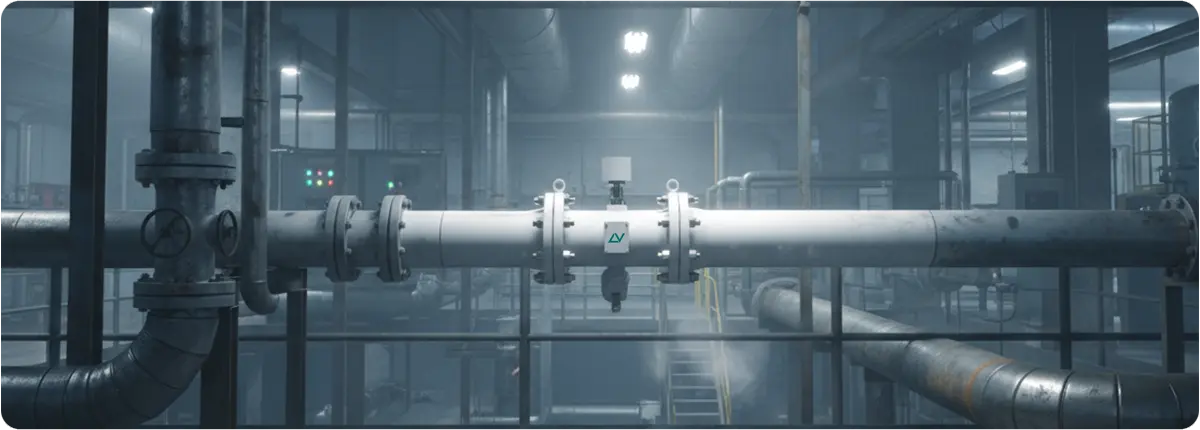
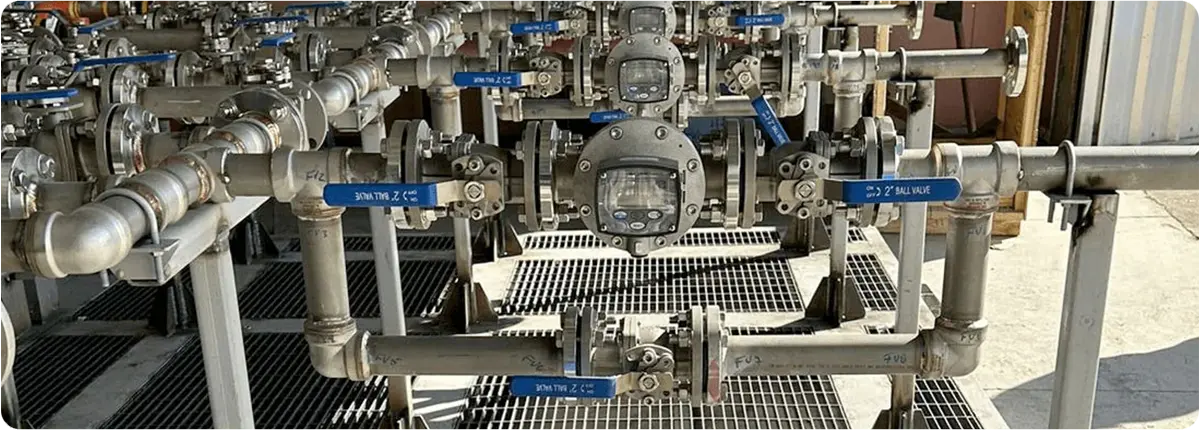
Piston flowmeters are positive displacement flowmeters designed to provide high-accuracy measurement. They measure fluid volume through a reciprocating piston mechanism, making them ideal for low flow rates and high-viscosity fluids. Due to their reliability, they are widely used in chemical, pharmaceutical, food, oil, and automotive industries.

WORKING PRINCIPLE

In piston flowmeters, fluid enters a chamber where a piston moves back and forth. Each piston stroke displaces a fixed volume of fluid, which is then counted by mechanical or electronic sensors. The total volumetric flow rate is determined based on the number of cycles.

Basic equation:
Qv = n · Vc
Qv: volumetric flow rate (m³/s)
n: piston stroke frequency (Hz)
Vc: displaced volume per stroke (m³).

This principle ensures high accuracy, even at very low flow rates, and is less sensitive to pressure fluctuations.

STRUCTURAL FEATURES

  • Body materials: stainless steel, aluminum, cast iron
  • Measuring element: piston-cylinder mechanism
  • Output signals: mechanical register, magnetic pickup, pulse output
  • High-pressure resistance
  • Low pressure drop and high repeatability

ADVANTAGES AND LIMITATIONS

Advantages:

  • Very high accuracy (±0.1% – ±0.5%)
  • Effective for low flow measurements
  • Reliable for viscous fluids
  • Durable and long-lasting design

Limitations:

  • Maintenance required due to moving parts
  • Reduced lifespan with abrasive or particulate fluids
  • Limited use in large-diameter pipelines

APPLICATION AREAS

  • Solvent, resin, and polymer measurement in chemical industries
  • Precise dosing in pharmaceuticals
  • Measurement of syrup, honey, and oils in food industry
  • Oil and fuel measurement in automotive industry
  • Lubrication systems and hydraulic applications in energy sector

STANDARDS AND CALIBRATION

  • OIML R 117: International standard for liquid measuring devices
  • ISO/IEC 17025: Calibration laboratory accreditation
  • ATEX-certified models for explosive environments
  • Regular calibration is essential for maintaining accuracy over time

CONCLUSION

Piston flowmeters are highly reliable in low-flow and high-viscosity conditions. They play a critical role in industries requiring precise dosing and accurate volumetric flow measurement.

Helical rotor flowmeters are a special type of positive displacement flowmeter. They operate based on the principle of axial helical rotors being rotated by the fluid flow. Each rotation of the rotor represents a fixed and known volume, ensuring high accuracy and repeatability. They are widely used in petroleum, chemical, pharmaceutical, and food industries, particularly for measuring high-viscosity fluids.

Helical Rotor Flowmeters

WORKING PRINCIPLE

As the fluid passes through the meter, it causes the helical rotors to rotate axially. The rotation displaces a fixed volume of fluid, which is measured to calculate volumetric flow.

Basic equation:
Qv = n · Vc
Qv: volumetric flow rate (m³/s)
n: rotor rotation frequency (Hz)
Vc: displaced volume per rotation (m³).

Helical rotor flowmeters are less affected by fluid density and viscosity, providing stable and accurate performance.

STRUCTURAL FEATURES

  • Body materials: stainless steel, cast iron, aluminum
  • Measuring elements: helical (screw-type) rotors
  • Output signals: magnetic pickup, pulse, digital signals
  • Low pressure drop
  • Excellent performance with high-viscosity fluids

ADVANTAGES AND LIMITATIONS

Advantages:

  • High accuracy (±0.2% – ±0.5%)
  • Reliable performance at low flow rates
  • Suitable for viscous and dense fluids
  • Minimal pressure loss

Limitations:

  • Moving parts require maintenance
  • Reduced lifespan with abrasive fluids
  • Less suitable for fluids containing solid particles

APPLICATION AREAS

  • Fuel and oil measurement
  • Polymer and solvent monitoring in chemical industries
  • Syrup, molasses, and honey measurement in food industry
  • Precise dosing in pharmaceutical applications
  • Lubrication systems in energy and automotive sectors

STANDARDS AND CALIBRATION

  • OIML R 117: Standard for liquid measuring devices
  • ISO/IEC 17025: Calibration laboratory accreditation
  • ATEX-certified models for explosive environments
  • Regular calibration is necessary to maintain accuracy

CONCLUSION

Helical rotor flowmeters play a vital role in industries requiring precise measurement of high-viscosity fluids. With their robust design, low pressure drop, and reliable accuracy, they provide long-term and dependable solutions for demanding industrial applications.

Gear flowmeters are a type of positive displacement flowmeter that measure volumetric flow by using intermeshing gears. As the fluid moves through the chamber, it drives the gears to rotate, and each rotation corresponds to a fixed volume. Due to their ability to provide accurate measurements with viscous fluids and at low flow rates, gear flowmeters are widely used in industries such as oil, chemical, pharmaceutical, food, and automotive.

Gear Flowmeters

WORKING PRINCIPLE

In gear flowmeters, the fluid passes through a chamber containing two precision gears. As the fluid flows, it causes the gears to rotate. Each gear rotation corresponds to a known volume, which is counted to calculate the total flow.

Basic equation:
Qv = n · Vc
Qv: volumetric flow rate (m³/s)
n: gear rotation frequency (Hz)
Vc: displaced volume per rotation (m³).

They are especially accurate in low flow and high viscosity applications.

STRUCTURAL FEATURES

  • Body materials: stainless steel, cast iron, aluminum
  • Measuring elements: precision intermeshing gears
  • Output signals: magnetic pickup, pulse output, digital signals
  • High-pressure resistant designs
  • Wide measuring range (from 0.01 l/min up to hundreds of l/min)

ADVANTAGES AND LIMITATIONS

Advantages:

  • Very high accuracy (±0.1% – ±0.5%)
  • Reliable for viscous fluids
  • Precise measurement even at low flow rates
  • Compact and durable construction

Limitations:

  • Moving parts require maintenance
  • Reduced lifespan with abrasive or particulate fluids
  • Limited by high-temperature conditions

APPLICATION AREAS

  • Hydraulic oil and fuel measurement
  • Solvent and polymer measurement in chemical industries
  • Syrups, honey, oils in the food industry
  • Precision dosing in pharmaceuticals
  • Lubrication systems in automotive applications

STANDARDS AND CALIBRATION

  • OIML R 117: Standard for liquid measuring devices
  • ISO/IEC 17025: Calibration laboratory accreditation
  • ATEX-certified models for explosive environments
  • Regular calibration is essential for accuracy

CONCLUSION

Gear flowmeters are reliable and accurate instruments, particularly suitable for viscous fluids and low flow rates. Their durability and precision make them one of the most efficient flowmeter options in industrial measurement applications.

Positive displacement (PD) flowmeters are precision instruments that measure flow by dividing the fluid into fixed volumes and counting these volumes as they pass through the meter. Because they operate on a volumetric principle, they provide excellent accuracy at low flow rates and with highly viscous fluids. They are widely used in oil, chemical, pharmaceutical, food, and automotive industries.

Positive Displacement Flowmeters

WORKING PRINCIPLE

PD flowmeters measure flow by separating the fluid into known volumes within a mechanical chamber and counting these cycles. Each cycle corresponds to a fixed volume, and the number of cycles is proportional to total flow.

Equation:
Qv = n · Vc
Qv: volumetric flow rate (m³/s), n: cycle frequency (Hz), Vc: chamber volume (m³).

Common types include:

  • Oval gear meters
  • Piston meters
  • Helical rotor meters

STRUCTURAL FEATURES

  • Body materials: stainless steel, cast iron, aluminum
  • Measuring elements: oval gears, pistons, helical rotors
  • Output: mechanical register, magnetic pickup, digital pulse
  • Excellent performance with viscous fluids
  • Capable of measuring very low flow rates

ADVANTAGES AND LIMITATIONS

Advantages:

  • Very high accuracy (±0.1% – ±0.5%)
  • Suitable for low flow measurement
  • Excellent performance with viscous fluids
  • No external power required (mechanical designs)

Limitations:

  • Moving parts require periodic maintenance
  • Wear from abrasive or particulate fluids
  • Limited use in very large pipe diameters

APPLICATION AREAS

  • Fuel and oil measurement
  • Solvent and polymer measurement in chemical industries
  • Syrup, honey, and oils in the food industry
  • Precise dosing in pharmaceuticals
  • Hydraulic systems for oil flow monitoring

STANDARDS AND CALIBRATION

  • OIML R 117: International standard for liquid measuring devices
  • ISO/IEC 17025: Calibration laboratory accreditation
  • ATEX-certified models for explosive environments
  • Regular calibration is essential to maintain accuracy

CONCLUSION

Positive displacement flowmeters provide unmatched accuracy and reliability, especially under low flow and high viscosity conditions. They are indispensable for applications requiring precise dosing and consumption measurement across various industries.

Thermal mass flowmeters are devices that measure mass flow using the principle of heat transfer. They are particularly effective for gas measurement, providing high accuracy in industries such as chemicals, energy, environmental technologies, HVAC, and process control. With no moving parts, they offer low maintenance and long service life.

Thermal Mass Flowmeters

WORKING PRINCIPLE

Thermal mass flowmeters work by measuring the amount of heat carried away from a heated sensor by the flowing fluid. Two main principles are applied:

  • Convective heat transfer: The heater element is kept at a constant temperature, and the heat carried away by the fluid is proportional to flow velocity.
  • Differential temperature method: The temperature difference between two sensors is measured and correlated to flow.

Basic equation:
Qm = k · ΔT
Qm: mass flow rate (kg/h), k: calibration constant, ΔT: temperature difference (°C).

STRUCTURAL FEATURES

  • Sensors: heating element and reference temperature sensors
  • Materials: Stainless steel, Inconel, Teflon coatings
  • Output signals: 4-20 mA, Pulse, HART, Profibus, Modbus
  • Optional pressure and temperature compensation
  • ATEX-certified models for explosive environments

ADVANTAGES AND LIMITATIONS

Advantages:

  • Direct mass flow measurement (no density compensation required)
  • High accuracy (typically 1% – 2%)
  • No moving parts, minimal maintenance
  • Wide measurement range

Limitations:

  • Accuracy may be reduced in dusty or particulate-laden flows
  • Primarily limited to gas measurement
  • Limitations under very high pressure and temperature conditions

APPLICATION AREAS

  • Natural gas and biogas measurement
  • Airflow control in HVAC systems
  • Chemical and petrochemical processes
  • Emission monitoring in environmental technologies
  • Combustion control in power plants

STANDARDS AND CALIBRATION

  • ISO 14511: Standard for thermal flowmeters
  • EPA and TÜV certified models for emission measurement
  • ATEX certification for explosive environments
  • Regular calibration is essential for maintaining accuracy

CONCLUSION

Thermal mass flowmeters are vital instruments for gas flow measurement, offering high accuracy, low maintenance, and broad industrial applicability. Their compatibility with digital communication protocols ensures seamless integration into modern process automation systems.

Coriolis flowmeters are among the most accurate instruments for directly measuring mass flow. Based on the Coriolis effect, these devices can simultaneously measure additional parameters such as fluid density, temperature, and viscosity. Due to their unmatched accuracy, they are widely used in chemical, petrochemical, food, pharmaceutical, energy, and oil & gas industries.

Coriolis Flowmeters

WORKING PRINCIPLE

Coriolis flowmeters measure mass flow by detecting the phase shift caused when fluid passes through vibrating tubes. The tubes are set into oscillation by electromagnetic drivers. As the fluid flows, a measurable phase difference appears between the inlet and outlet ends of the tube, which is proportional to the mass flow.

Basic equation:
ṁ = k · Δφ
ṁ: mass flow rate (kg/s), k: calibration constant, Δφ: phase shift (radians).

Additionally, the natural vibration frequency of the tubes is used to measure fluid density:
ρ = f(ω)
ρ: density, ω: vibration frequency.

STRUCTURAL FEATURES

  • Measuring tubes: U-shaped or dual straight tube designs
  • Materials: Stainless steel, Hastelloy, or corrosion-resistant alloys
  • Sensors: Electromagnetic or optical detection
  • Output: 4-20 mA, HART, Profibus, Modbus, Foundation Fieldbus
  • Additional functions: Density, temperature, and viscosity measurement

ADVANTAGES AND LIMITATIONS

Advantages:

  • Direct mass flow measurement
  • Very high accuracy (±0.1% – ±0.2%)
  • Simultaneous density and temperature measurement
  • No moving parts, minimal maintenance

Limitations:

  • High initial cost
  • Heavy and expensive for large pipe diameters
  • Sensitive to vibrations and installation conditions

APPLICATION AREAS

  • Chemical and petrochemical industry: measurement of acids, bases, and solutions
  • Oil and gas industry: mass flow measurement
  • Food and beverage production: sugar solutions, milk, beer, etc.
  • Pharmaceutical industry: precise formulations
  • Energy sector: fuel feed and process control

STANDARDS AND CALIBRATION

  • ISO 10790: International standard for Coriolis flowmeters
  • OIML R 137: International standard for gas flow measurement devices
  • ATEX-certified versions: For explosive environments
  • Regular calibration is essential to maintain accuracy

CONCLUSION

Coriolis flowmeters provide unmatched accuracy and versatility by offering direct mass flow measurement combined with density and temperature monitoring. They are indispensable instruments in modern process industries, particularly where precision and reliability are critical.

Ultrasonic flowmeters are modern instruments that measure flow using the propagation of sound waves. They are highly durable due to their non-intrusive design, require minimal maintenance, and can measure liquids, gases, and multiphase flows. They are widely used in water management, energy, petrochemical, food, and pharmaceutical industries.

Ultrasonic Flowmeters and Industrial Applications

WORKING PRINCIPLE

Ultrasonic flowmeters operate primarily using two methods: transit-time difference and Doppler effect.

• Transit-time method: Measures the difference in travel time between ultrasonic signals sent with and against the flow. This difference is proportional to flow velocity.

Basic equation:
v = (Δt · c²) / (2 · L · cosθ)
v: fluid velocity, Δt: time difference, c: speed of sound, L: distance between sensors, θ: angle of the signal

• Doppler method: Measures the frequency shift of sound waves reflected from particles or bubbles in the fluid. The shift is directly proportional to flow velocity.

STRUCTURAL FEATURES

  • Sensors: Mounted externally (clamp-on) or inserted into the pipe
  • Measurement range: from very low to high flow rates
  • Outputs: Pulse, 4-20 mA, HART, Profibus, Modbus
  • Data integration: Digital display and SCADA compatibility

ADVANTAGES AND LIMITATIONS

Advantages:

  • Non-intrusive measurement (clamp-on)
  • No moving parts, low maintenance
  • High accuracy (±0.5% – ±1)
  • Suitable for liquids, gases, and multiphase flows

Limitations:

  • Accuracy affected by fluid temperature, viscosity, and pipe material
  • Performance decreases in non-homogeneous flows
  • Doppler method requires particles or bubbles in the fluid

APPLICATION AREAS

  • Water and wastewater monitoring
  • Measurement in oil and gas pipelines
  • Cooling water control in power plants
  • Hygienic flow measurement in food and beverage industry
  • Process control in pharmaceutical production

STANDARDS AND CALIBRATION

  • ISO 6416: Standard for ultrasonic flow measurement
  • AGA reports: Gas measurement standards
  • ATEX-certified models for explosive environments
  • Regular calibration required to maintain accuracy

CONCLUSION

Ultrasonic flowmeters have become essential in modern industries thanks to their non-intrusive design, accuracy, and low maintenance requirements. Their ability to integrate with digital communication protocols makes them a reliable choice for process automation and optimization.

Turbine flowmeters are highly accurate instruments that measure flow by detecting the rotational speed of a turbine placed in the flow path. As the fluid moves through the pipe, it spins the turbine, and the speed of rotation is proportional to the flow velocity. They are widely used in oil, natural gas, chemical, food, pharmaceutical, and water management industries.

WORKING PRINCIPLE

The fluid flow turns the turbine rotor, and its rotational speed corresponds to the volumetric flow rate. Magnetic or optical sensors detect the rotor’s movement and convert it into an electrical signal.

Basic equation:
Q = k · N

Where Q is the flow rate (m³/s), k is the calibration constant, and N is the number of turbine revolutions per unit time.

STRUCTURAL FEATURES

  • Material: stainless steel, aluminum, or special alloys
  • Rotor: aerodynamically designed to minimize resistance
  • Bearings: sapphire or tungsten carbide for long life and low friction
  • Output: Pulse signal, 4-20 mA, HART, Modbus

ADVANTAGES AND LIMITATIONS

Advantages:

  • High measurement accuracy (0.2% – 0.5% error)
  • Wide flow measurement range
  • Suitable for both gases and liquids

Limitations:

  • Accuracy decreases with viscous or contaminated fluids
  • May be unstable at very low flow rates
  • Requires periodic calibration and maintenance

APPLICATION AREAS

  • Fuel measurement in oil and gas industry
  • Natural gas consumption monitoring in power plants
  • Flow control in water management and treatment facilities
  • Measurement of liquid raw materials in food and pharmaceutical industries

STANDARDS AND CALIBRATION

  • ISO 9951: Turbine meters for gas flow measurement
  • AGA reports: Standards for natural gas measurement
  • API and ASME compliance
  • Regular calibration required to maintain accuracy

CONCLUSION

Turbine flowmeters provide exceptional accuracy and reliability in industrial flow measurement. With digital communication protocols, they can be seamlessly integrated into SCADA and automation systems, playing a vital role in process optimization and monitoring.

Flow measurement is one of the most essential parameters in industrial processes. Accurate flow monitoring ensures energy optimization, process safety, and product quality. Variable area flowmeters, most commonly represented by rotameters, are widely used due to their simplicity and reliability.

Flow Measurement Techniques

WORKING PRINCIPLE

A variable area flowmeter consists of a tapered tube with a float inside. As fluid flows upward, the float rises until the upward force of the fluid balances with gravity. The position of the float corresponds to the flow rate, which can be read directly.

Q = C · A(h) · √(2ΔP / ρ)

Where Q is flow rate (m³/s), C is discharge coefficient, A(h) is the cross-sectional area depending on float height, ΔP is pressure drop, and ρ is fluid density.

MAIN COMPONENTS

  • Tapered glass or metal tube
  • Float element
  • Scale and indicator system
  • Optional: Electronic sensors and transmitter integration

ADVANTAGES AND LIMITATIONS

Advantages:

  • Simple and robust design
  • Direct visual reading
  • No external energy required

Limitations:

  • Sensitive to viscosity and density variations
  • Cannot be used in horizontal pipelines
  • Limited accuracy in high-precision processes

APPLICATION AREAS

  • Water and wastewater treatment plants
  • Chemical industry for liquids and gases
  • Laboratory environments for low flow rates
  • Food and pharmaceutical industries for basic process control

STANDARDS AND CALIBRATION

  • ISO 5167: Flow measurement devices
  • OIML R117: International metrology standard for liquid flow measurement devices
  • Periodic calibration is required to ensure accuracy

CONCLUSION

Variable area flowmeters remain widely used due to their low cost, simplicity, and reliability. The introduction of electronic rotameters has enabled digital monitoring and integration with SCADA systems, making them more versatile in modern industries.